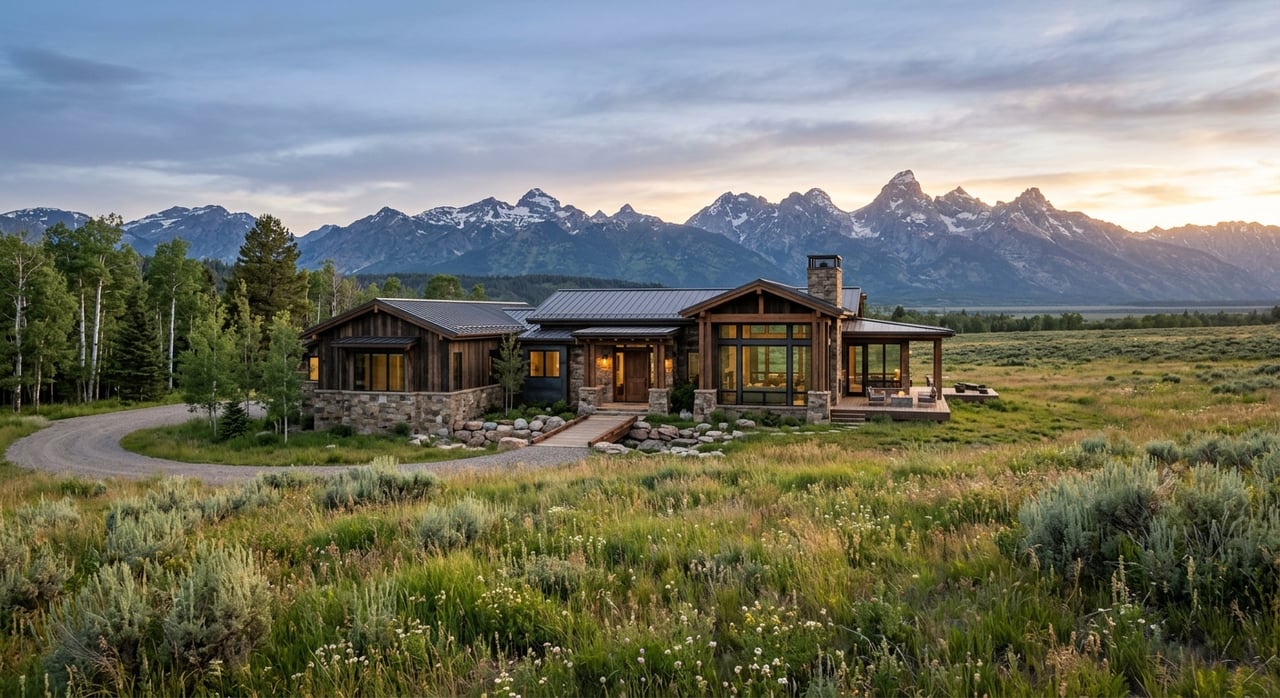
Luxury Acreage North Of Jackson: Space, Views, Access
May 28, 2026
May 28, 2026
If you are searching for luxury acreage north of Jackson, you are probably looking for more than just a larger lot. You want breathing room, protected views, and a property that feels both private and practical. In this part of Teton County, those qualities are shaped as much by zoning, overlays, and siting as they are by acreage alone. Let’s dive in.
North of Jackson holds a special position in the valley. Jackson sits at the southern end of Jackson Hole, while Grand Teton National Park begins just north of town, and Jackson Hole Airport is located inside the park. That geography gives this corridor a rare mix of open space, mountain views, and convenient access.
For many buyers, that combination is the draw. You can be close to town, near the airport, and still feel surrounded by meadow, butte, and mountain scenery. In a market where setting matters as much as square footage, north-of-Jackson acreage stands apart because it offers lifestyle and land value in the same package.
In this corridor, luxury acreage is not simply about owning a big parcel. The more useful question is whether the land can support a homesite, possible outbuildings, and enough natural separation to avoid feeling exposed to neighbors or the road. That is what tends to create the true estate feel buyers are after.
In county zoning terms, that often means looking at rural density bands from 3 to 20 acres, with some legacy ranch holdings much larger. As a practical rule, the 10 to 20 acre range often starts to feel estate-like, while 70 acres is a clearer threshold for ranch-scale land. That distinction matters if you are comparing an elegant homesite with a true long-hold legacy property.
Teton County’s rural residential districts include one dwelling unit per 3 acres, 5 acres, 7.5 acres, 10 acres, and 20 acres. Those density bands help shape what a parcel can feel like on the ground. A 10-acre parcel may offer a very private residential experience, but a 70-acre holding begins to sit in a different category entirely.
Working ranch subdivisions have a minimum base site area of 70 acres and are capped at one dwelling unit per 35 acres. County regulations also define agriculture for sites of 70 acres or more. So when buyers talk about “legacy land” north of Jackson, they are often describing holdings that meet or exceed that 70-acre benchmark.
One reason acreage north of Jackson commands so much attention is simple: there is not much of it. Historical county planning materials showed that 97 percent of the county was federally owned, leaving only a small share as private land. Those same materials identified the airport and golf-and-tennis corridor as one of the county’s remaining pockets of developable private land.
That helps explain why land here can feel scarce and strategic rather than plentiful. Larger parcels often remain in long-term family ownership or are shaped by conservation planning. When a compelling parcel becomes available, buyers are not just evaluating land area. They are evaluating rarity.
One of the biggest misconceptions in this market is that more acreage automatically means better privacy and better views. In reality, visibility, vegetation, topography, and road orientation often matter more. A smaller parcel with thoughtful siting can feel more private than a larger one with broad exposure.
North of Jackson also falls within a visually sensitive landscape. The Scenic Resources Overlay applies to the North Highway 89 scenic area from South Park Loop Road to the Grand Teton National Park boundary. That overlay reflects the county’s effort to preserve the valley’s most frequently viewed scenic resources.
Within scenic areas, development is generally expected to sit at the rear or side edge of meadows or pastures, behind existing vegetation, behind a natural topographic break, or as part of a clustered ranch compound. If a project is within 1,320 feet of a state highway or county scenic road, native plantings may be expected to reflect historic ranchstead patterns.
In some cases, applicants may also need a Visual Resource Analysis. That review can address building bulk, roof forms, materials, colors, and landscaping so improvements blend into the setting. The important point for buyers is this: scenic rules usually do not eliminate development potential, but they can strongly influence where a home can be placed and how visible it will be.
If privacy is one of your top goals, the real question is not “How many acres?” It is “Where can improvements sit, and how hidden can they be from roads and neighboring viewpoints?” In north-of-Jackson acreage, that answer often depends on natural vegetation, terrain breaks, meadow edges, and overlay rules.
County planning materials make an important distinction here. Scenic and natural-resource overlays generally do not reduce a parcel’s overall density or development potential. Instead, they tend to shape siting, screening, and visibility, which means a parcel’s privacy value comes from how the land works, not just how much of it there is.
The Natural Resource Overlay is another major part of the picture. Its purpose is to protect critical habitat, migration routes, nesting habitat, and trout spawning areas. Current county code also identifies the region as part of the Greater Yellowstone Ecosystem and references wildlife and habitat sensitivity as a key planning factor.
For buyers, this means due diligence matters. A beautiful creek edge, open meadow, or wildlife corridor may add to the character of a property, but it may also affect where improvements can go. This is one reason north-of-Jackson acreage deserves parcel-level analysis instead of broad assumptions.
Some buyers assume that a conservation easement makes a parcel unbuildable. That is not necessarily true. Some conserved parcels still allow limited residential density, and larger protected lands at one house per 70 acres or less and 320 acres or more may qualify for certain scenic-standard exemptions, though skyline rules can still apply.
The key is understanding the exact terms of the easement and how they interact with current county regulations. A preserved property can still be highly valuable and usable, but the development envelope may be more specific than buyers expect.
Access is one of the strongest advantages of this corridor. Jackson Hole Airport is inside Grand Teton National Park and is identified by the National Park Service as the only commercial airport within a national park in the United States. Grand Teton lies just north of Jackson, and Yellowstone’s South Entrance is reached through Grand Teton.
That access can be hard to match in other mountain markets. For second-home owners and frequent travelers, the ability to reach a private acreage setting without sacrificing airport convenience is a major part of the appeal. It supports both lifestyle use and long-term desirability.
At the same time, access is not the whole story. Proximity to the park and airport also means buyers should think about seasonal traffic, gateway corridor sensitivity, and road conditions at different times of year. A parcel may look ideal on a map, but its experience can vary depending on ingress, exposure, and surrounding travel patterns.
That is why the best acreage purchases here balance convenience with buildability, privacy, and view quality. The premium is rarely about one factor alone.
Recent market commentary from a local brokerage reported that vacant land sales rebounded in 2025, with a median land sale price of $1.85 million. The area north of Jackson saw the biggest jump in activity, while average days on market stretched to 227 days. That combination suggests renewed interest, but also a buyer pool that is selective.
The same source reported that land made up only 13 percent of area transactions, with 54 vacant-land parcels listed for sale at mid-year 2025. In a county where inventory is limited and every parcel has its own regulatory and physical story, buyers tend to move carefully. Unique land can draw strong interest, but fit matters.
Broader county pricing remains elevated as well. Redfin reported a March 2026 median sale price of $2.4 million in Teton County, up 1.2 percent year over year. In other words, north-of-Jackson acreage sits inside a high-value market where rarity, view protection, and regulatory alignment shape value as much as location itself.
If you are comparing luxury acreage north of Jackson, it helps to look past the listing headline and focus on how the parcel actually functions. A smart review usually includes:
County planning pages direct users to the current Comprehensive Plan, Land Development Regulations, and amendments through Municode. Because zoning and overlay status can change over time, parcel-specific verification is essential before making assumptions about use or future plans.
In a market like this, luxury acreage is not a plug-and-play purchase. Two parcels with similar acre counts can offer very different levels of privacy, visual protection, and development flexibility. The difference often comes down to local knowledge, careful reading of county rules, and experience seeing how these properties trade in real life.
That is where working with a deeply rooted local advisor can make the search more efficient and more informed. If you are considering a purchase or thinking about how to position a north-of-Jackson landholding for sale, Meredith Landino can help you evaluate the details that truly drive value in this part of Teton County.
Stay up to date on the latest real estate trends.